There's a good chance you're wrong about the End of History
Its most common critique is the weakest.
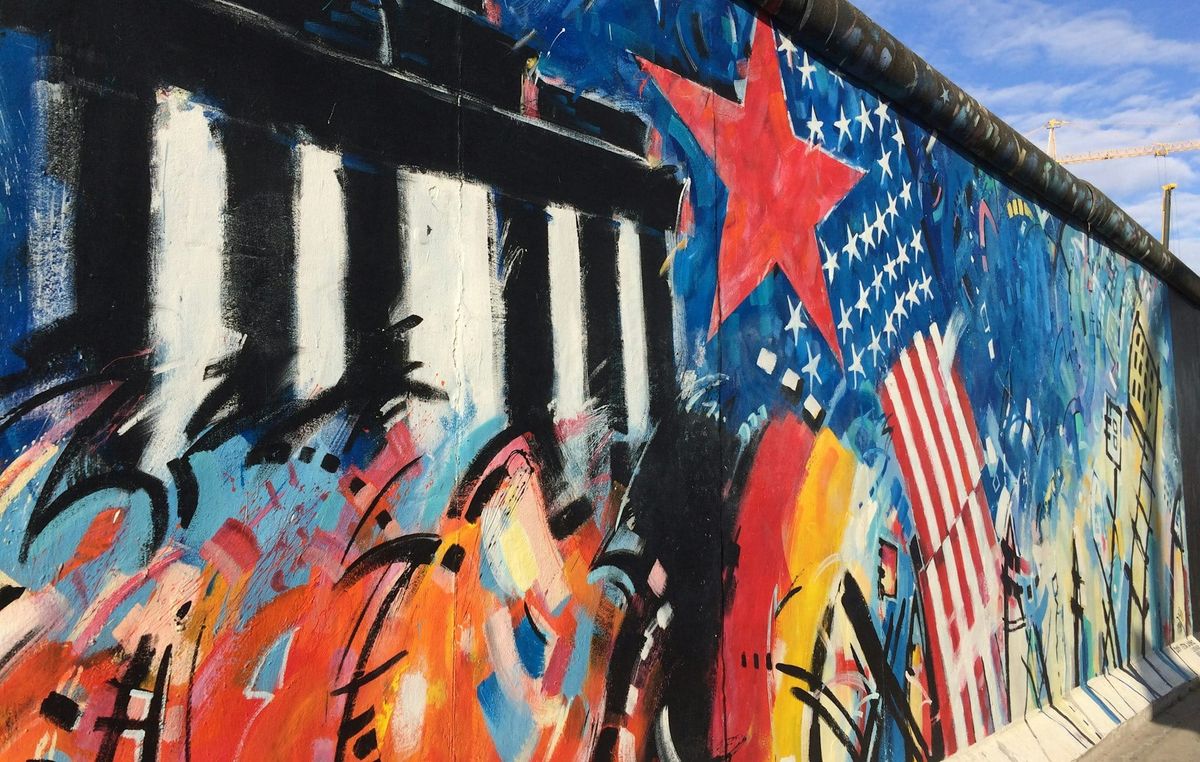
In his 1989 essay "The End of History?" in The National Interest, Fukuyama argued that the USSR's policy of Glasnost and Perestroika signalled the beginning of the end of the decades-long struggle between capitalism and communism. Soviet socialism had reached a dead-end; the liberal alternative had not. Fukuyama expanded the article into the 1992 book The End of History and the Last Man, but the thesis is the same: mankind had reached the End of History.
The common critiques of the End of History
Fukuyama's thesis has been often criticised because history did not end in the 90s. For example, on 7 June 2025, Philip Stephens wrote in the Financial Times:
Fukuyama was far from alone in suggesting this shared prosperity marked the end of wars between states.
On 17 July 2024, Matt Bai wrote in the Washington Post:
Fukuyama was wrong, of course; liberty did not enjoy some final triumph over autocracy in the world, or even much of a honeymoon.
On 02 February 2025, Prof. Joseph Stiglitz wrote in El País:
Fukuyama called this moment the "end of history", predicting that all societies would eventually converge towards liberal democracy and the market economy. Today, it's almost a cliché to observe how wrong that prediction was.
And that's to say nothing of the brutal takedowns on social media.
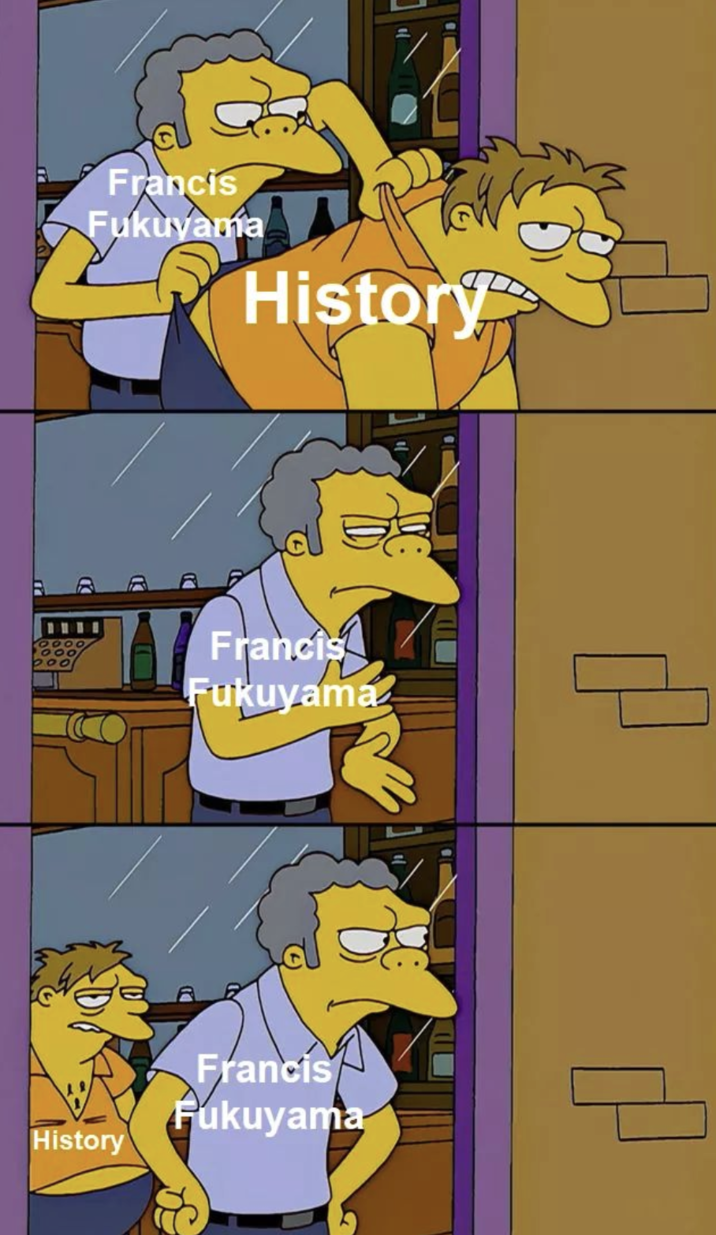
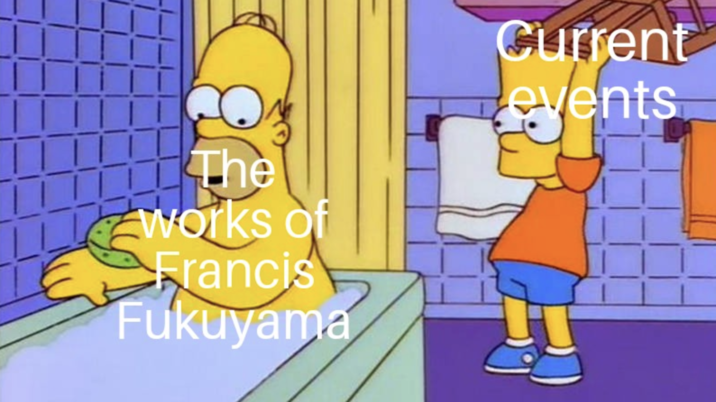
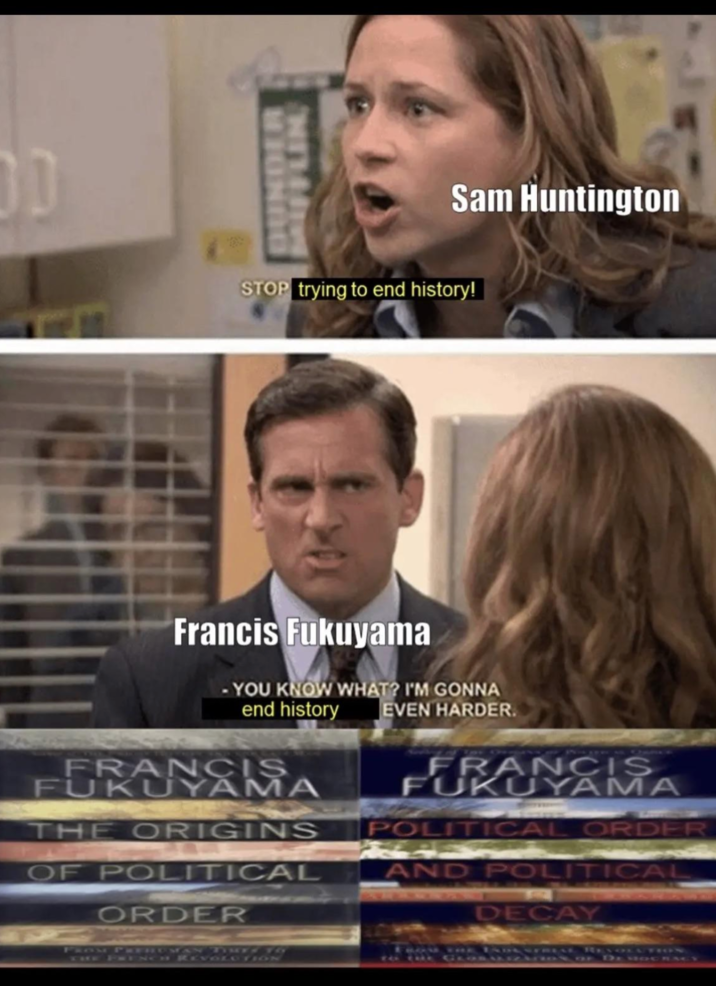
Twitter, BungaCast; Reddit, HistoryMemes; Reddit, /r/NonCredibleDiplomacy; all courtesy of Know Your Meme
But the History in the End of History is not about events happening. Fukuyama states this early in his essay:
This is not to say that there will no longer be events to fill the pages of Foreign Affairs' yearly summaries of international relations, for the victory of liberalism has occurred primarily in the realm of ideas... and is as yet incomplete in the real or material world. - The End of History?
Yet the misrepresentation persists: the idea that Fukuyama said events would stop happening, that war would end, or that liberal democracy would rapidly spread to the illiberal corners of the world. This misrepresentation is often expressed as shorthand for the sake of journalistic simplification. The problem is that many readers mistake the shorthand for the substance.
This isn't to say there are no legitimate criticisms of the End of History. Derrida and Huntington have offered their own. But this article isn't about the legitimate criticism (or the legitimate criticism of the legitimate criticisms). This article concerns the folk misunderstanding of the End of History, which misses how Fukuyama was writing in and against the Marxist historical tradition. And to understand that Marxist tradition, we need to talk about dialectics.
What Marx meant by history
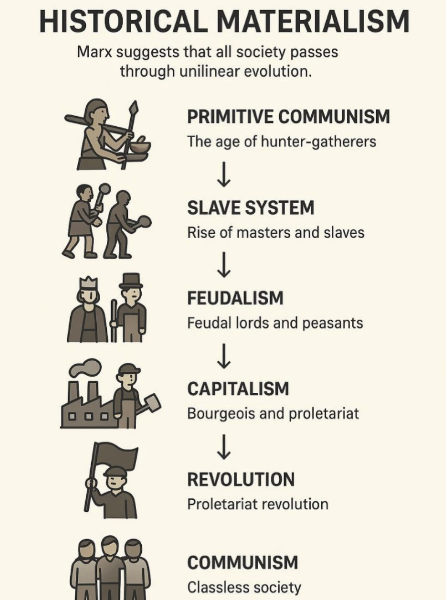
Marx argued that history is, simply, humanity's socio-political development. In this developmental framework, all societies began as tribes living in primitive communism. These tribes later formed slave societies, like ancient Rome, who displaced primitive communism through conquest and economic power. These slave societies then transitioned to feudalism, who later became absolutist monarchies, which then transitioned to capitalism and its bourgeoisie institutions like constitutions, private property, liberalism and democracy. But it doesn't end there. Capitalism was then meant to transition to socialism, and from socialism to communism.
Per Marx, History is humanity's progression through these stages of socio-political development. History in the sense of 'events' can delay or hasten progress through these stages, but the direction of History through these stages remains the same.
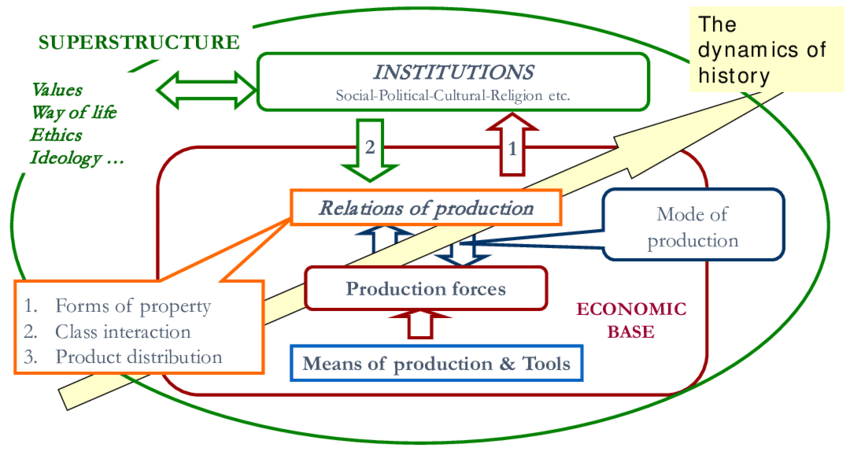
Marx argued that this Historical progress is dialectic.* It's a process of thesis-antithesis-synthesis between the forces of production, which include labour and capital, and relations of production (which class owns what). The friction between these forces creates contradictions. For example, capitalism's contradictions are between socialised production (the proletariat) and private ownership (the bourgeois). This alienation of labour from the value it creates leads to conflict, culminating in the worker's revolution. And it's not just capitalism, every stage is brought down by the weight of its contradictions. Every stage except communism, whose forces and owners of production are one and the same, so it has no contradictions. That's why there's no stage after communism, it's the end of History.
*Strictly speaking, thesis-antithesis-synthesis comes from Fichte. Marx never used these terms, but it's common and useful shorthand.
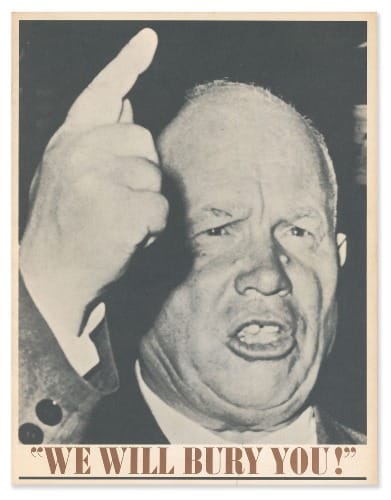
Per Marx, societies could delay their transition but never escape it. Just as a doctor might prolong the life of a terminally-ill patient, capitalism could stall but never escape its fate. Soviet leader Nikita Khrushchev expressed this on 18 November 1956, saying: "Whether you like it or not, history is on our side. We will bury you!". His words were misinterpreted at the time as a nuclear threat, but Khrushchev clarified on 24 August 1963 that the historical forces inherent in capitalism would destroy it from within. The process might take decades, even centuries, but the destination was certain.
What Fukuyama meant by the End of History
Fukuyama's "The End of History?" was written in conversation with Marx. It asked if communism was, actually, the end of history? No, and it was clear even before the Berlin Wall fell and the USSR dissolved. Liberal democracy and market capitalism had won the battle of ideas. They, Fukuyama argued, were the End of History, the end point of humanity's socio-political development.
Fukuyama illustrates this by examining East Asia. There, following World War I, the rising ideology was fascism, not democracy. But fascism discredited itself in military defeat and political self-destruction, and the United States imposed liberal democracy on the defeated Japan. If liberalism was just a stepping stone to socialism, or incompatible with Japanese values, then Japan should have rejected this Western graft. But it embraced it. Japanese democracy is very different from that of other democracies, yet it's one of the most liberal states in the world, more free than the USA by some measures.
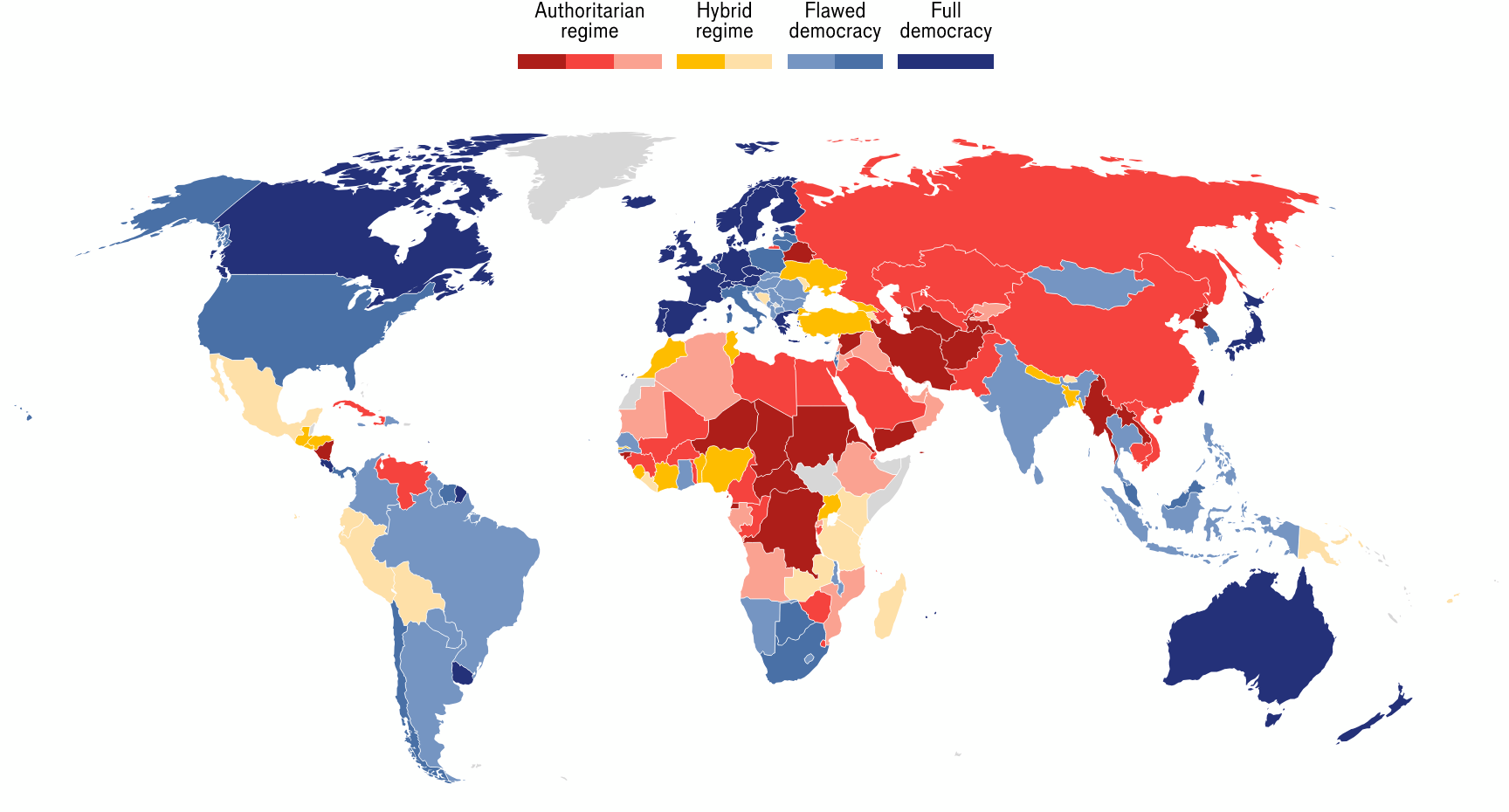
America also imposed on the defeated Japan its capitalist economic framework, and this too it embraced. Fukuyama illustrates its success by the fact that after Iran's 1979 Revolution, advertising for Sony, Hitachi, and JVC products continued to be displayed in Tehran. It was easier to effect the downfall of the Shah than the end of consumer electronics. We see similar ubiquity in the cultural clout of liberal democratic Korea, from Parasite to K-Pop. Liberal democratic Taiwan's TSMC is integral to the global economy. Liberal democracy and the market economy first emerged in the West, but they have spread far and, in places, put down deep roots.
And it's not just East Asia. Liberal democracy and market capitalism have been adopted by societies as diverse as Australia, Botswana, Costa Rica, Denmark, Estonia and Fiji. Many democracies are culturally remote from the Western European societies where liberal democracy first emerged, and several (Botswana, Costa Rica, Estonia) had no meaningful tradition of it before the 20th century. Yet each has made the model work on its own terms. Many more aspire to join them. Few-to-none of today's serious state actors aspire to Marxism-Leninism, let alone theocracy, fascism, or restored absolutism. The fact that many dictators feel the need to hold sham elections implicitly concedes the moral superiority of the liberalism they reject in practice.
Liberalism and market capitalism have spread far because they are flexible. A capitalist system might be cuddly or cut-throat; it's still capitalism. A state might have a generous welfare state or a miserly one, both exist at the End of History. A liberal democracy might be presidential or parliamentary, it might have many parties or only 1.5, but it can still be a liberal democracy. These systems are flexible enough that all nations might use them, and desirable enough that many want to.

What critics get wrong
So where do the misconceptions come from? For one, many people read the title "The End of History?" and no further. And to give these people who judge the book by its cover their due, the title is provocative by design. But being misread because of a punchy title is different from being wrong, just ask Jonathan Swift.
Nor was it helped by the zeitgeist in 1989. Americans felt triumphant, which many non-readers projected onto Fukuyama's work. And that mistake is perpetuated by writers who understand Fukuyama's work but reduce it to journalistic shorthand. The problem is that many today think this shorthand is all there is to it.
The End of History did not mean an end to war
As Philip Stephens wrote on 7 June 2025 in the Financial Times:
"The defeat of communism, <Fukuyama's> thesis ran, marked the triumph not just of western democracy, but also the economic liberalism that had ushered in another era of globalisation. Fukuyama was far from alone in suggesting this shared prosperity marked the end of wars between states. Vladimir Putin was not listening".
But as FT readers pointed out, Fukuyama actually said that war was not over:
This does not by any means imply the end of international conflict per se. For the world at that point would be divided between a part that was historical and a part that was post-historical. Conflict between states still in history, and between those states and those at the end of history, would still be possible. - The End of History?
The End of History did not mean clashing civilisations
Stephens was not the only one to misread Fukuyama. On 17 July 2024, Matt Bai wrote:
Then came the end of the Cold War — what the social theorist Francis Fukuyama optimistically called “the end of history.” By this, he meant that absolutism in all its forms — monarchy, fascism, communism — had finally exhausted itself, to be permanently replaced by liberal democracies created in our image. We were supposed to be living through, in effect, the last battle of the broader American revolution. Fukuyama was wrong, of course; liberty did not enjoy some final triumph over autocracy in the world, or even much of a honeymoon. But he was right in the sense that the civilizational clashes that had long dominated our political discourse suddenly disappeared.
This is even worse than Stephens' misreading. Fukuyama never said monarchy, fascism or communism would be replaced permanently with democracies made in the USA's image; indeed, Fukuyama once said the goal of modern political institutions was "Getting to Denmark" (not Getting to America). Bai also credits Fukuyama with foreseeing that civilisational clashes were disappearing. However, Fukuyama never defined the End of History in terms of clashing civilisations. But Samuel Huntington did. He wrote Clash of Civilisations to critique the End of History, not support it. Conflating the End of History's thesis with one of its most serious and substantive critics, as Bai does, is a major misattribution.
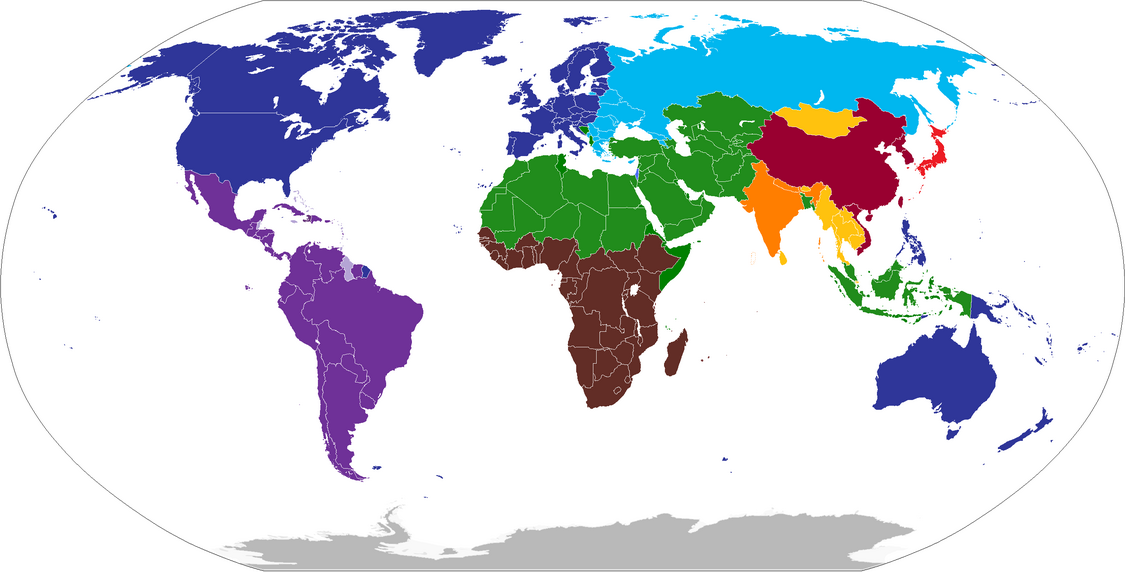

Fukuyama is more careful in his article. He doesn't engage with Huntington's clashing civilisations, but concedes that nationalism and terrorism exist at the End of History:
There would still be a high and perhaps rising level of ethnic and nationalist violence, since those are impulses incompletely played out, even in parts of the post-historical world... terrorism and wars of national liberation will continue to be an important item on the international agenda. - The End of History?
The End of History did not mean the sudden end of autocracy
Another misunderstanding is that the End of History meant liberal democratic capitalism would spread across the world quickly or without setback. On 02 February 2025, Prof. Joseph Stiglitz wrote in El País (in Spanish):
Francis Fukuyama llamó a este momento el “fin de la historia”, prediciendo que todas las sociedades terminarían convergiendo hacia la democracia liberal y la economía de mercado. Hoy en día es casi un cliché observar lo equivocada que estaba esa predicción. Con el regreso de Donald Trump y su movimiento MAGA [siglas en inglés del lema “Hacer grande a América otra vez”], tal vez deberíamos llamar a la era actual el “fin del progreso”.
Which in English reads:
Francis Fukuyama called this moment the "end of history", predicting that all societies would eventually converge towards liberal democracy and the market economy. Today, it's almost a cliché to observe how wrong that prediction was. With the return of Donald Trump and his MAGA movement of the slogan “Make America Great Again”, perhaps we should call the current era the “end of progress”. - El Pais, translated from Spanish
But contrary to Stiglitz, Fukuyama argued that the End of History would not be quick or easy at all. He wrote in 1989:
Ultranationalists in the USSR believe in their Slavophile cause passionately and one gets the sense that the fascist alternative is not one that has played itself out entirely there... given the Soviet Union's size and military strength, for that power will continue to preoccupy us and slow our realization that we have already emerged on the other side of history.
- The End of History?
Fukuyama's End of History is in the realm of ideas, not facts on the ground, and the translation of ideas into reality can be long. Fukuyama cheekily noted that the End of History was actually at the Battle of Jena in 1806 - endorsing Alexandre Kojève's reading of Hegel on the matter. It was at Jena that Napoleon, the flawed torch-bearer of liberalism and capitalism, defeated Prussia, the embodiment of feudalism and absolutism.
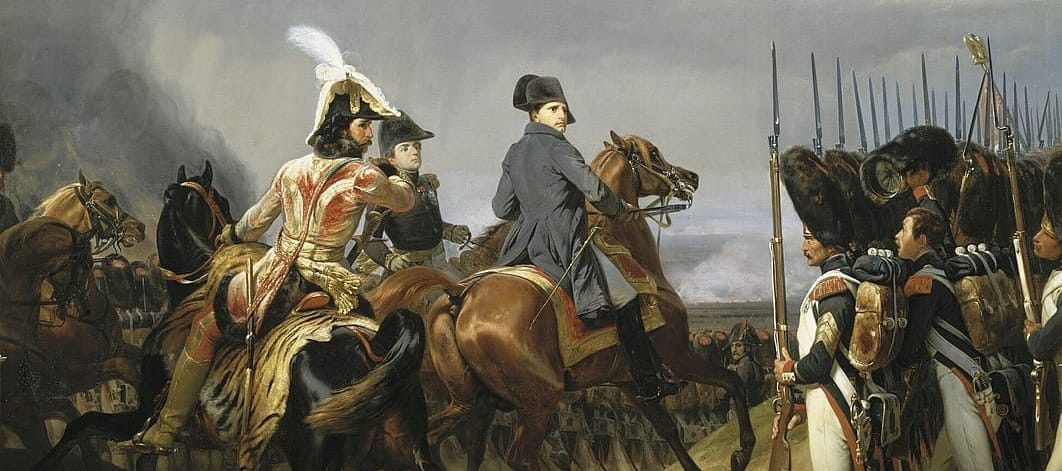

It was at Jena that the liberal capitalist idea was finally embodied in important, victorious historical forces. The liberal capitalist idea could finally begin to change the world as it existed. Fukuyama writes:
While there was considerable work to be done after 1806 - abolishing slavery and the slave trade, extending the franchise to workers, women, blacks, and other racial minorities, etc. - the basic principles of the liberal democratic state could not be improved upon. The two world wars in this century and their attendant revolutions and upheavals simply had the effect of extending those principles spatially. - The End of History?
In 1989, liberalism and capitalism had, similarly, won the battle of ideas over communism. However, the process of translating that into the material world could take a long time. Contra Stiglitz, the 36 years since the End of History was published has been very brief in the longue durée of history. A more defensible assessment of the End of History is to echo Zhou Enlai who allegedly said of the French Revolution (No, not that one) "it's too early to tell".
No serious rival has yet emerged
Fukuyama did not argue that liberal democracy had solved every problem, or that no challenger could ever arise. He argued that, as of 1989, no coherent ideological alternative was left standing. Fascism had discredited itself in 1945. Soviet socialism was discrediting itself as he wrote. Theocracy was, and remains, a regional phenomenon without universal appeal. Fukuyama claimed that liberalism and capitalism had won the battle of ideas; he never said victory was permanent.

Whether the field is still empty is a reasonable question to ask. Samuel Huntington asked it most famously, arguing in 1993 that civilisational identity, not liberal universalism, would structure the 21st century. Others have pointed to China's state-led model, political Islam, or techno-authoritarianism as candidate rivals. Whether any of these constitutes a coherent, exportable model that resolves contradictions liberalism cannot is a question for another essay. Suffice to say that Fukuyama is alive to the possibility that history may "restart". He has written extensively on the topic of challenges to liberalism. Liberalism stands undefeated in the realm of ideas for now, but future challenges may arise.
What would it take for history to restart? Fukuyama's invocation of the Battle of Jena is instructive here. In 1806, much of humanity lived under feudal and absolutist regimes. Liberal regimes were anomalies, not torch-bearers. Regimes like the early American republic were liberal (flawed and promissory though its liberalism was), but its liberalism was only possible where there was no centuries old monarchy to displace. In the old world, liberalism would never replace the absolutism of long-established monarchies.
This thought was challenged by the French Revolution. The Bourbon monarchy was toppled, yes, but its successor republics were unsustainable and seemed to be proof positive that liberalism would not replace absolutism. Try yes, succeed no, because liberalism was not an exportable model. But that changed after Jena. When Napoleon's forces of liberalism (flawed and promissory though its liberalism was) defeated the aristocracy of old Europe, people realised liberalism can replace absolutism. Liberalism was no longer an anomaly but the future.
Such was the case for Soviet Socialism. It won its Battle of Jena in 1917, and its revolutionaries sought to export the model from Cuba to Cambodia. But the Revolutions of 1989 put the process in reverse. Socialism that had seemed at the vanguard of history was in-fact an unsustainable, 74-year anomaly. It was not the End of History it purported to be.
The End of Misunderstanding the End of History?
Fukuyama never argued that events would stop, that wars would end, or that liberal democracy would spread quickly and smoothly. His argument was narrower and more defensible: that by 1989, liberal democracy embedded in a market economy had won the battle of ideas, and that no coherent and serious alternative had taken the field. That's it. That's the End of History.
Whether that accurately describes the world today is a separate question. The rival that finally defeats liberalism could be hiding now in Beijing, Tehran or Silicon Valley. It could turn out that liberal capitalism contains the seeds of its own destruction after all; just not the seeds that Khrushchev had in mind. Fukuyama himself has written about such challenges extensively. Serious critics like Huntington, Derrida, and others have offered their own arguments.
But none of these critiques are what most commentary invokes when it declares the end of the End of History. Most commentary invokes a folk caricature: that Fukuyama said events would stop, events haven't stopped, therefore Fukuyama was wrong. This is a weak attack on a position Fukuyama never held. All it proves is that the author's understanding of The End of History extends no further than the cover of the book.
Appendix: Meta / Changelog
My main caveat by far is that I based this analysis almost solely on Fukuyama's article The End of History? for The National Interest. I did not draw on his later book The End of History and the Last Man because:
- I don't expect readers to digest the entire book, but I think it's reasonable to link and suggest they read the long-form magazine essay.
- Fukuyama's article is more prescient than his book. The article was written before the fall of the Berlin Wall, whereas the book was written after.
- I have read The End of History and the Last Man and I consider the core argument fundamentally unchanged from article to book, at least as relates to the common misunderstanding that events would stop happening.
I'd have liked to spend more time on what I think are reasonable critiques of the End of History. However, this piece was meant to correct misconceptions about the End of History and only that. At ~3,500 words I think the piece is fine in terms of length, and I'd rather make one argument well than spread two arguments thin. However, if I hadn't managed my scope so mercilessly I'd have liked to cover:
- I'd have liked to unpack Fukuyama's own writing on trans-humanism as a means by which history might "restart". But I've not read it, and didn't want to delay publication a few months to read it, so I make no claims to understand it.
- These arguments are unpacked more in Fukuyama's book than the article, and this post mainly draws on the article, so I'd have had to engage more with the book if I engaged with these ideological rivals, and I wasn't going to do that for a short analysis like this.
- Whether and how new technologies might enable previously unfathomable post-liberal forms of government is an interesting question, but highly speculative and deserving of a lengthier treatment.