Links 2019–01
A link is not an endorsement, but it sure is interesting.
A link is not an endorsement, but it sure is interesting.
Read
Enlightenment Wars: Some Reflections on ‘Enlightenment Now,’ One Year Later
I like Pinker’s response but I’m always sad how much of this response has unpick the critics’ double standard.
The recurring fallacy in lamentations of modernity is “to compare an idealized past, its vices overlooked, with a demonized present, its virtues overlooked.”
If you’ve not read Enlightenment Now! then you get the greatest hits here
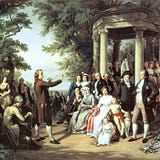
Steven Pinker on slavery and the Enlightenment
Apologies for double dipping Marginal Revolution this month.
This strikes me as a classic case of mood affiliation: “we must have a positive mood toward the Enlightenment!” And perhaps we must. But what is wrong with this alternative formulation?:
“Early modern Europe, including its later manifestation of the Enlightenment, brought great benefits to the world. Part of those benefits involved enhanced capacities. Some of those enhanced capacities were used to do great evil”
Now this is a more thought out criticism of Enlightenment Now!
I would note also that so many of the most radical abolitionists, including in Britain, were Christians. It is fine to consider them part of the Enlightenment as well, but still to describe the Enlightenment as “the inventor of the notion that no one should be held as a slave” seems off-base to me. The 16th century Spanish Salamancans — theologians I might add — strongly opposed slavery well before the Enlightenment.
Although this raises the question, are you suggesting that we must have a more positive mood toward Christians, Tyler? Perhaps we must. But what is wrong with an alternative formulation?

A short history of the creation of regions in Ghana
I used to get really incensed that post-colonial nations maintained their colonial borders. Their national identity was a European fiction! But the more I read about European history, there really shouldn’t be Alsatians in France, Catalans in Spain, Cornish in England, or Switzerland.
As part of the First World War, the British and the French took over German Togoland and divided it between themselves. The League of Nations, formed after the war, recognised British occupancy of its part which they called Trans-Volta Togoland and mandated them to administer it on behalf of the League.

The Keys to a Great Rebrand
Before Spotify rebranded, it saw itself as a tech company… the company had tapped out most of its early adopters, who were into the music technology, and needed to make inroads with people who didn’t care for “engineered-driven language around music,” as Collins puts it.
“When you want to scale, you can’t just speak to early adopters; you have to have a broader, more popular language,” he says. “The aesthetic and the symbols Spotify was using all said ‘engineering’ when they really should’ve been saying, ‘Wouldn’t you like to listen to this great piece of music?’

The Media Botched the Covington Catholic Story
An under-argued approach to many controversies is to point out that leaders and institutions fail to live up to their own standards. Not that their critics’ standards are valid and everyone should make their critics happy. But by their own stated commitment to integrity, the NYT and many others failed.
How could the elite media — The New York Times, let’s say — have protected itself from this event, which has served to reinforce millions of Americans’ belief that traditional journalistic outlets are purveyors of “fake news?” It might have hewed to a concept that once went by the quaint term “journalistic ethics.” Among other things, journalistic ethics held that if you didn’t have the reporting to support a story, and if that story had the potential to hurt its subjects, and if those subjects were private citizens, and if they were moreover minors? You didn’t run the story.

What would actually put more working-class people in office?
Very few revolutionary leaders were working class. Successful firebrands are almost always disgruntled elites. Robespierre was a lawyer. George Danton was a dyslexic lawyer. Lenin’s father was a regional primary school director. Mao’s was one of the wealthiest farmers in Shaoshan. Stalin was unusually raised in poverty by was the first in his family to go to school.
When party leaders look for new talent, they often look to their own friends and acquaintances. And since most party officials are well off, they usually don’t have many working-class people in their social networks…
If we don’t pay politicians enough, the story goes, only rich people will be able to afford to hold office. And if elections were publicly financed, more working-class people could afford to run.
But working-class people don’t run because they can’t afford to take time off to campaign, not because the salary for winners is too low.
File under: the crisis of liberalism is the cultural, geographic and economic segregation of the upper-middle class from everyone else.

So you think you know diet?
If you read Marginal Revolution, you know how hard it is for Tyler Cowen to outright say something. But this time he does, and he’s not the only one.
People, I am not trying to claim this is true! As is so often the case, I am trying to confuse you and persuade you that maybe you know less than you think.

The Right Needs To Grow Up On Environmentalism
Don’t forget the Burkean impulse to not just explode complex systems!
Conservatives believe — or ought to believe — in low time preferences, prudence and restraint, the fragility of order, and the love of home. The Left’s apparent use of environmental matters as Trojan horses for egalitarian and internationalist ambitions has no doubt raised hackles on the Right but it is the all-but-unqualified embrace of free market capitalism, has led to an almost absolute abandonment of the field to the Left. Yes, free market capitalism has enabled growth and innovation, but it is also a force for presentism, insecurity and greed.

Watch
The British Film Institute has kindly compiled the best of video essays of 2018
When a new movie is released, the odds are stacked against audiovisual critics. Before they can engage with the material they have to wait for the movie to find its way onto a streaming service or for it to be released on DVD or Blu-ray. This inescapable delay is frustrating… but it is also a blessing. It is an incubation period that allows opinions to ferment and that makes the video essay a form of slow, sustainable criticism.
I’m not even only half way through but here are some highlights:
Disney, The Magic of Animation Kaptainkristain
PlayTime, Controlled Chaos Andrew Saladino (The Royal Ocean Film Society)
Comparing Every Version of A Star Is Born Be Kind Rewind
Based on a True Story Zackery Ramos-Taylor
Why James Bond sounds like James Bond Dan Golding
Michael Bay: Understanding A True American Auteur Patrick H Willems
Kiki’s Delivery Service: The Millennial Starving Artist Debra Minoff & Susannah McCullough (ScreenPrism)
See With Your Ears: Spielberg and Sound Design Evan Puschak (The Nerdwriter)
Watch them all here